
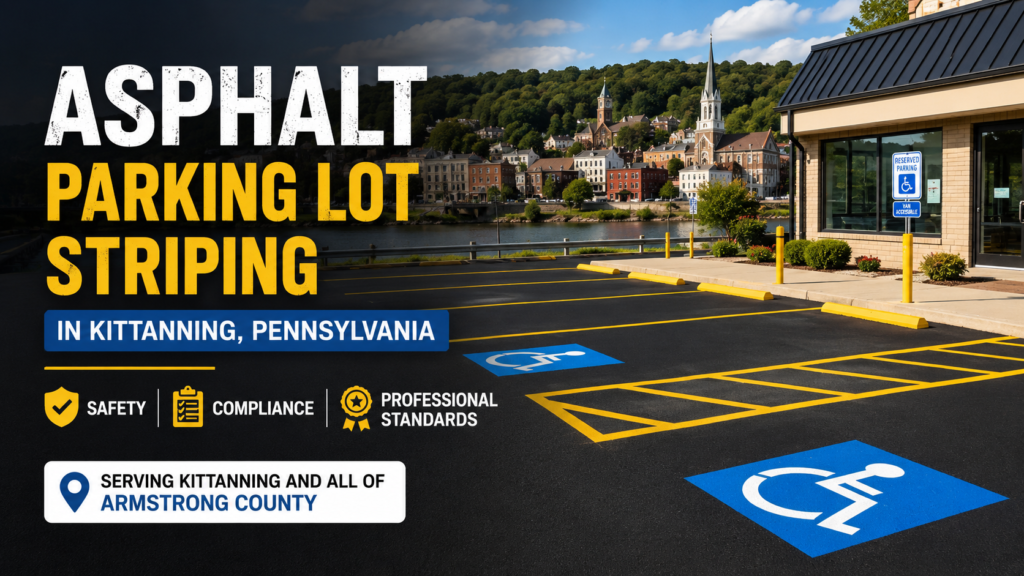
Asphalt Parking Lot Striping Kittanning is a service that sits at the intersection of safety management, legal compliance, and professional property presentation. For commercial property owners, institutional facilities managers, and municipal administrators in Kittanning, Armstrong County, and Western Pennsylvania, the condition of parking lot markings directly affects how safely and efficiently drivers navigate their parking facilities, whether ADA accessibility requirements are being met, and what impression the property makes on visitors and customers. Understanding what professional parking lot striping involves, what standards govern the work, and when restriping is necessary helps Kittanning area property managers make informed decisions about this essential pavement maintenance service.
What Parking Lot Striping Covers
Professional parking lot striping in Kittanning encompasses far more than simply painting white lines for parking spaces. A complete striping program addresses:
- Standard parking stall lines: White or yellow lines defining individual parking spaces at the correct width (typically 9 feet for standard stalls in Pennsylvania commercial applications) and depth (18 to 20 feet for typical passenger vehicle stalls), applied at the appropriate angle for the traffic flow configuration.
- ADA accessible parking spaces: Blue and white accessible space designations, including the required pavement markings, correct stall and access aisle dimensions, and the International Symbol of Accessibility. The number of accessible spaces, their dimensions, their slopes, and their signage must meet both federal ADA standards and Pennsylvania-specific requirements.
- Fire lane markings: Red curb paint and fire lane text stenciling required by fire codes in commercial parking areas. Fire lanes must be clearly marked and maintained to ensure emergency vehicle access.
- Traffic directional arrows: Guiding one-way or directional traffic flow through parking areas and access drives.
- Pedestrian crosswalks: Crosswalk markings connecting accessible parking areas, building entrances, and pedestrian pathways across vehicle traffic lanes.
- Stop bars: Pavement control markings at lot entrances, exits, and internal intersections.
- Loading zone and no-parking designations: Yellow curb markings and text designating restricted parking areas for commercial loading, fire apparatus access, or other restricted uses.
ADA Requirements for Parking Lots in Pennsylvania
The Americans with Disabilities Act establishes enforceable minimum standards for accessible parking in any facility open to the public. For commercial properties in Kittanning, these requirements include:
- Minimum space count: A lot with 1 to 25 total spaces requires 1 accessible space; a lot with 26 to 50 requires 2; the requirement scales upward with total lot size. At least one in every six accessible spaces must be van-accessible.
- Dimensions: Standard accessible spaces must be at least 8 feet wide. Van-accessible spaces require either an 8-foot space with an 8-foot access aisle, or an 11-foot space with a 5-foot access aisle.
- Slope compliance: Accessible spaces and their access aisles must not exceed 2 percent slope in any direction. Spaces on portions of a lot where the natural slope exceeds this limit may not be designated as accessible.
- Signage: Each accessible space requires a vertical sign bearing the International Symbol of Accessibility, mounted at the correct height. Pavement markings alone do not satisfy the signage requirement.
- Accessible route: An accessible route from the parking area to the building entrance must be provided, meeting ADA slope, width, and surface requirements.
Failure to meet ADA requirements exposes commercial property owners to enforcement actions and civil complaints. The penalty for first ADA violations can reach $75,000 under U.S. Department of Justice enforcement.
Why Lines Fade and When Restriping Is Required in Western Pennsylvania
Parking lot striping in Kittanning and Armstrong County fades over time from several forces that are particularly relevant in the Western Pennsylvania climate:
- UV exposure: While Western Pennsylvania is not as UV-intensive as the Southwest, summer sun still bleaches traffic-grade paint, causing white lines to gray and yellow lines to lighten.
- Freeze-thaw cycling: The mechanical action of freeze-thaw cycling on the asphalt surface loosens the bond between paint and pavement over time, accelerating fading and peeling of traffic markings.
- Sealcoating: When sealcoating is applied to the asphalt surface an important maintenance practice for extending pavement life in Armstrong County climate it covers existing line markings. Restriping is always required after sealcoating and should be scheduled as part of the same project.
- Snow plowing: Winter plowing operations in Western Pennsylvania are particularly hard on pavement markings. Plow blades in contact with the pavement surface abrade markings, and snowplow operations using chains or studded edges can physically scrape markings off.
Most professional striping companies in Western Pennsylvania recommend restriping every 2 to 3 years for typical commercial lots, with higher-traffic lots potentially needing annual touch-up.
The Striping Application Process
Professional parking lot striping in Kittanning follows a structured process that produces consistent, durable results:
- Surface preparation: The asphalt surface must be clean and dry. Sweeping and blowing remove loose debris, sand, and accumulated dirt that would prevent good paint adhesion.
- Layout planning: For new layouts or reconfigured lots, the contractor plans the space configuration to maximize stall count while maintaining required fire lane widths, ADA-compliant accessible spaces, and appropriate drive aisle widths (typically 20 to 24 feet for two-way traffic).
- Layout marking: Chalk lines or tape guide marks are applied to ensure straight, correctly positioned lines before paint is applied.
- Paint application: Traffic-grade latex or alkyd paint is applied using professional striping machines that maintain consistent line width (typically 4 inches for stall lines) and film thickness. Consistent film thickness is critical for durability.
- Stenciling: Arrows, symbols, text, and the International Symbol of Accessibility are applied using professional stencils.
Conclusion
Asphalt parking lot striping in Kittanning is a professional service that directly affects safety, ADA legal compliance, and property presentation for commercial facilities throughout Armstrong County. Understanding what comprehensive striping covers, what ADA requires, why Western Pennsylvania climate accelerates marking deterioration, and what proper application involves positions property owners and facilities managers to maintain their parking lots in the condition that protects their visitors and meets their regulatory obligations.